
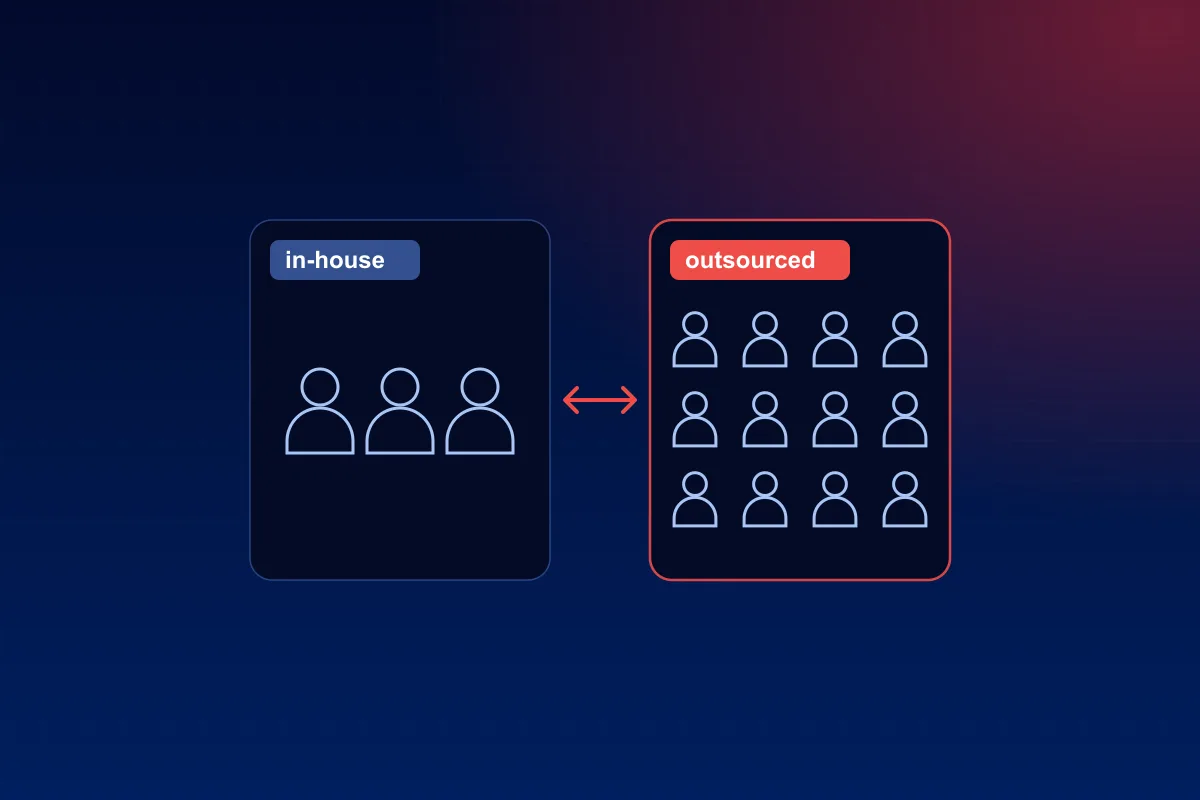
In short: label in-house when the right answer needs knowledge only your team has, when the volume is small, or when the data may not leave your systems. Outsource when the volume is large or uneven, the task can be written down, and you can check a sample of the results. Most teams end up doing both.
What in-house labeling gives you
- Control. The people who label sit next to the people who build the model. A question is answered in a minute.
- Context. Your team knows the product, the edge cases and why a label matters.
- Privacy. The data never leaves your systems.
What it costs: you hire, train and manage the labelers, you choose and run the tools, and you build the review process. When engineers or domain experts do the labeling themselves, the cost is their time on everything else.
What outsourcing gives you
- Scale, up and down. A vendor can put many trained annotators on a large batch and none on a quiet month.
- Speed. The team exists already. There is nobody to hire.
- A process. Training, review passes and quality checks are the vendor's daily work.
What it costs: you have to write the task down clearly, check the results yourself, and agree how the data is moved and protected.
Seven questions that decide it
- Can the task be written down? If a careful person can follow a guideline with examples, it can be outsourced. If the rule lives in three experts' heads, write it down first, or keep the work with them.
- How much data is there, and how steady is the flow? A few hundred items once: do it yourself. Thousands every month, or large bursts: a vendor absorbs the swings.
- Who can judge the right answer? Where it takes a radiologist, a lawyer or your own engineer, keep the judging in-house. The marking itself can often still be outsourced.
- How sensitive is the data? Some data may not leave the building. Much of it can, once it is de-identified and covered by a confidentiality agreement.
- How fast do you need it? Hiring and training a team takes time. A vendor can start with a small batch at once.
- Can you measure quality yourself? You need this either way. See how to measure data annotation quality.
- What is your team's time worth? Count the hours your own people would spend labeling, reviewing and managing, not only the vendor's quote.
The mixed model most teams end up with
- Your experts write the guideline, label a small reference set, and settle the hard cases.
- The vendor labels the volume and runs the first review.
- Your team checks a random sample of every delivery against the reference set.
This keeps the judgement where the knowledge is and moves the repetition to people who do it all day.
Try it without betting the project
You do not have to decide on paper. Run a small batch with a vendor on your real data, measure it, and compare it with what your own team produces. Our guide shows how to run a data annotation pilot. Before you ask for quotes, read how data annotation projects are quoted.
Where Pripton fits
Pripton Innovations labels images, video, text, audio and LiDAR data for AI teams: see the services page. Our AWS Marketplace listings report 98.5% average accuracy and more than 500 trained annotators. If a project falls below 96.5% accuracy, we rework it. To talk through your case, use the contact page.


