
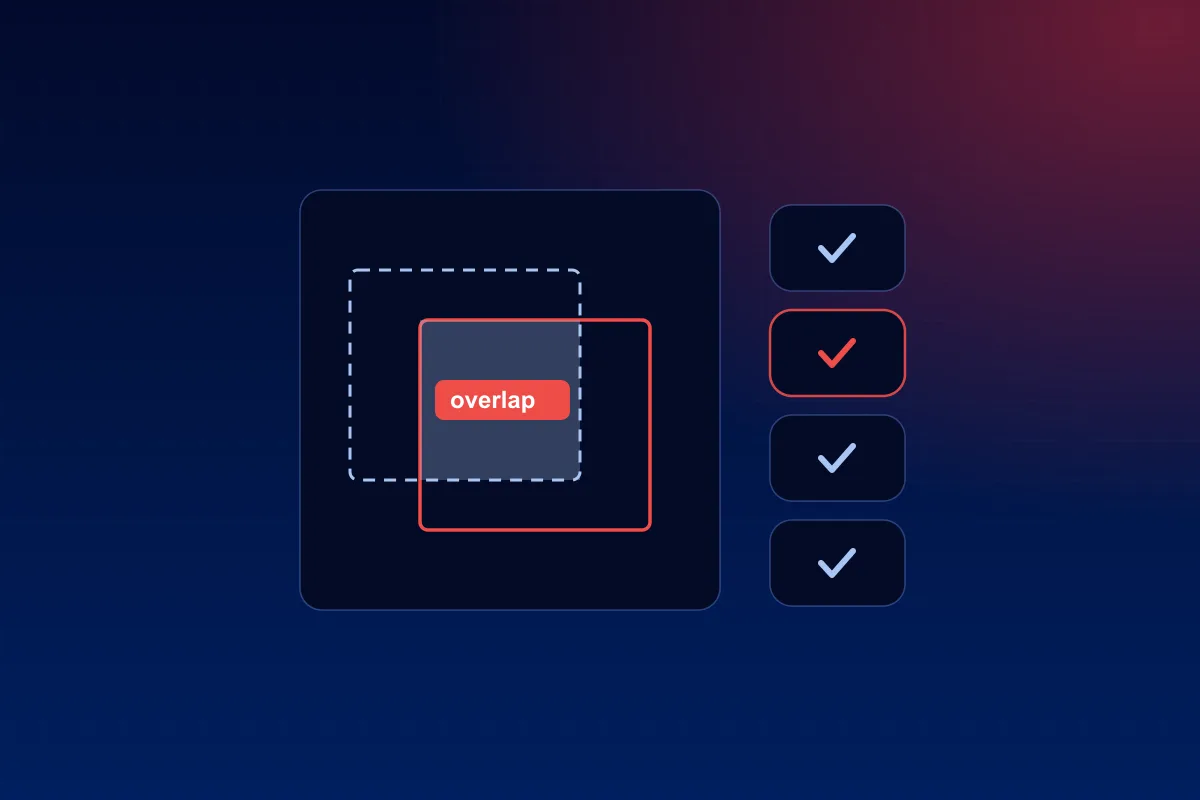
In short: three numbers tell you whether labeled data is good. Accuracy against a gold set says how often a label is right. Agreement between annotators says how clear the task is. For boxes and outlines, overlap says how well a shape fits. Take them on a random sample of every delivery.
1. Start with a written guideline
Quality means "matches the guideline". Without one, two honest people will label the same picture in two ways, and neither is wrong.
A guideline has to settle:
- the list of classes, with a definition and examples for each
- what to do with unclear, hidden or cut-off cases
- how tight a box or an outline must be
- what to do when no class fits
Every disagreement you find later is either an annotator's mistake or a gap in this document. Look for the gap first: closing it fixes the label for everyone at once.
2. Accuracy against a gold set
A gold set is a group of items whose correct labels your own experts have agreed. Mix them into the work without marking them. Accuracy is the share of gold items the annotators got right.
Two things make this number honest:
- Report it per class. A batch can look 98% accurate while a rare class is wrong half the time.
- Refresh the gold set. Add the hard cases you find, so that it keeps testing what is difficult.
3. Agreement between annotators
Give the same items to two annotators and compare. The simple measure is the share of items where they agree.
That share flatters easy tasks: two people who guess will still agree some of the time. Cohen's kappa corrects for this. It runs from -1 to 1. The scikit-learn documentation puts it this way: scores above 0.8 are generally considered good agreement, and zero or lower means no agreement (scikit-learn: Cohen's kappa).
Use agreement as a test of the guideline. Where two trained people disagree, read the cases together and rewrite the rule.
4. Overlap for boxes and outlines
For bounding boxes and segmentation, a label is a shape, and "right or wrong" is too coarse. The usual measure is intersection over union, written IoU:
- take the area where the annotator's shape and the reference shape overlap
- divide it by the area the two shapes cover together
1 means identical. 0 means they do not touch. Teams then choose a pass mark. A common one counts a box as correct at an IoU of 0.5 or more; stricter projects ask for 0.75 or more. Choose it with the people who train the model, because it decides how tight every box has to be.
5. How many items to check
- Sample at random, from every delivery, not only the first.
- Check enough. With 400 randomly chosen items, a measured accuracy is within about five percentage points of the true one, 19 times out of 20. With fewer items the reading swings more.
- Sample rare classes on their own. A random sample holds few of them.
- Check more at the start and after every change to the guideline.
What to put in the agreement
- the accuracy target, per class where it matters
- how it is measured: which sample, which gold set, who judges
- what happens below the target, and how fast the rework comes back
Settle this before the first batch. A pilot is the place to try the numbers out.
How Pripton works on quality
We label to your written guideline. Annotators are trained on it and on a test set before production, and labels are checked in a second pass before delivery. Our AWS Marketplace listings report 98.5% average accuracy. If a project falls below 96.5% accuracy, we rework it. To set the target for your data, use the contact page.


